01 · The handshake
Connect
A Daily Dignity Card meets the immediate need. The handoff starts a relationship and creates room for the next conversation.
Essentials today. A way out for good.
HOPE is a Hamilton program in process: a card designed to open food, transit, clothing and personal care, with a relationship—if the person wants one—that helps build what comes next. No cards have been issued yet, and this page shows exactly where the work stands.
It starts with a card in a hand. It becomes a relationship. The plan is written together, not handed down, and moves at the pace of small habits that hold. Each step opens support shaped around them: a home, health in body and mind, people who know their name, work they own, and dreams that get to be real again.
A card in a hand becomes a relationship. A plan written together turns small steps into housing, health, work, community and restored dreams.
$25 helps fund a full day of essentials.
Planning examples, not item-by-item promises. Vendor prices and first-unit economics are still being validated.
Continue the journey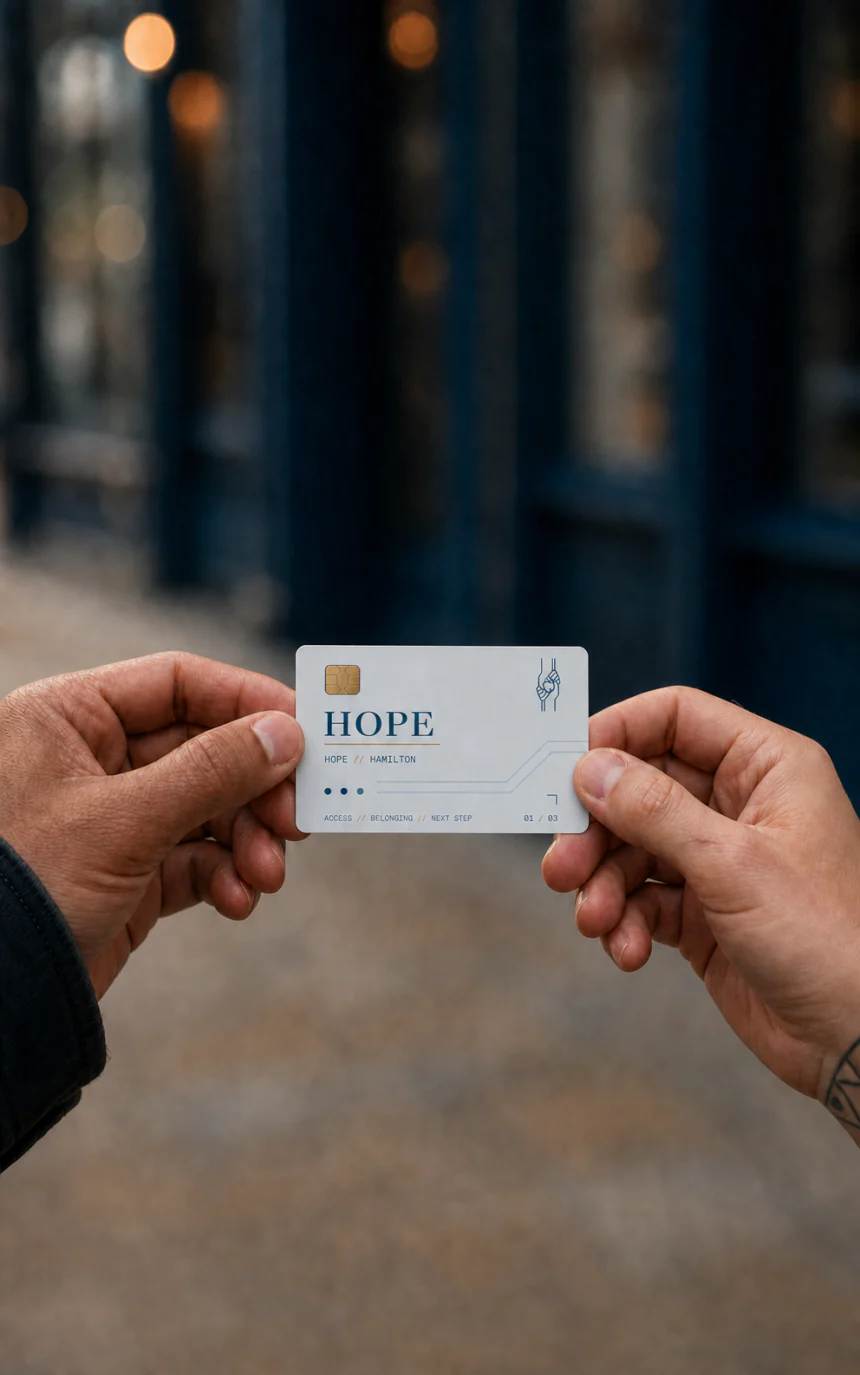 IN DEVELOPMENT
If someone offered you a HOPE card
The HOPE path
The words stay simple. Underneath them is the full HOPE journey: a card opens a relationship, discovery shapes the plan, and follow-through turns progress into restoration.
Swipe the three-step journey →
01 · The handshake
A Daily Dignity Card meets the immediate need. The handoff starts a relationship and creates room for the next conversation.
02 · Intake & discovery
Member, advocate and counsellor discover the goal, identify the funding need and build a Personal Vision Plan together.
03 · Restoration Track
Follow-through turns the plan into funded steps as personal goals are met and the Vision Plan is realized.
Card → relationship → plan → progress → restoration.
A story in the making
Early relationship-based learning is informing the design, but it is not a launched HOPE service or an outcome case. No story is ever a condition of support. When safety, consent and the person’s own timing allow, this space can carry the story in their words.
Start with the person, the immediate need and what they want life to become.
Turn restored dreams into practical steps, needs, funding moments and people who can stay.
Share only what is true, useful and freely offered—with dignity intact.
How it works
The proposed pilot brings gifts into one stewarded Hamilton pool. Give quickly by phone or help through an advocate already building trust face to face.
Planned flow · for anyone with a phone
See a HOPE card, scan it and choose an amount. The card can then open approved essentials at participating local vendors.
Planned flow · for advocates and outreach
Trained advocates carry cards through approved partner programs and hand them over inside a relationship that already exists. Trust travels with the card.
Advocates are 18 or older. Screening, references, a Vulnerable Sector Check and boundaries training are required before any contact with a member. Registering interest is not an assignment.
What it buys
HOPE value is designed to open approved essentials and practical supports across participating Hamilton businesses, with the experience staying clear at the counter: tap, choose and continue. These are the proposed categories. Each one depends on a signed vendor agreement, and those are in process.
Potential participating kitchens and cafés. A hot meal served with dignity.
Bus fare and tickets for appointments, work and a safe ride home.
Workwear, winter boots and practical layers through participating local vendors.
Laundry, barber and shower supports that make daily dignity practical.
The ladder
Daily dignity becomes a Personal Vision Plan. As trust and engagement grow, the plan matures into a Restoration Track with people and resources around it.
TodayDaily Dignity Card
Immediate food, transit, laundry and personal care make today more possible.
The card stays simple. The human relationship begins around it.
PlanPersonal Vision Plan
A member, advocate and counsellor build the plan together around the life the member wants.
Documents, health, recovery, work, education, housing and community become visible goals with a team around them.
RestoreRestoration Track
The plan a member built is funded step by step, with a person who knows them signing off rather than an automated score.
Micro-grants, larger purchases and direct provider payments support housing, treatment, education, tools and work readiness.
Members can see goals, achievements and next steps. Trusted partners validate progress in person, open the right supports and keep walking the plan toward restoration.
The loop
The proposed accountability loop will show that pooled gifts funded real essentials without exposing a member’s identity, vendor or location. Donors will see program-level evidence, not a person’s purchase history.
Pooling lets support follow need fairly. No single update will claim that one donor’s dollar can be traced to one person.
HOPE · gift landed
$25
Pooled illustration only. Donors are not shown who used support, which vendor, or where.
The engine
One pool, two proposed ways support is approved. They serve different purposes and follow different rules; keeping them distinct protects immediate dignity while larger steps receive human review.
Release one · the handshake
Designed to be fast, dignity-preserving and unconditional at the floor. Approved support would cover essentials at participating local vendors. Essentials do not depend on engagement or progress.
Purpose: survival and dignity, today.
The Restoration Track · the destination · phase two
The lane designed to change trajectories. Larger support would not accumulate on the card. Funding would be designated for a plan milestone and approved by a qualified support professional working under published criteria, after the plan is written with the member. Under the proposed model, the future receiving charity pays the provider directly.
Purpose: a changed trajectory.
Trust by design
Swipe through the commitments →
The receiving charity will be identified before payment and retain direction and control over charitable funds. Final settlement remains a human finance process.
Support stays within approved essentials at participating vendors or provider payments approved under the Restoration Track.
HOPE is not intended to duplicate agency case files. A future pilot will keep only the member information needed for card administration, consent, safety, support and accountable reporting. The data map, access roles, disclosure limits and retention rules will be published before member intake.
Food, transit, clothing and personal care are unconditional. They do not depend on engagement, progress, faith or a plan. A member can take a card and never speak to us again, and the essentials do not change.
Restoration is designed not to interfere with the City's established coordinated-access process. Where it helps, it can support arrears, deposits, furnishings and landlord assurance around that process, not instead of it.
Rent, treatment, tools and tuition are larger commitments, so they are planned with a member and would be reviewed by a qualified social-service, housing, health, education or employment professional under criteria published before launch. Review confirms fit, feasibility and responsible use of funds—not worthiness, compliance or personal behaviour. Clinical decisions, where relevant, remain with licensed professionals.
Radical accountability
We track stable restorations: housing that holds, goals that keep moving and relationships that stay connected over time. The count today is zero, because the pilot has not started. It will be published as it changes, and never derived from a group small enough to identify anyone.
Stable restorations.
Housing is a beginning. Community is the long game.
The proposed model follows progress from intake through two years after housing, pairing practical retention support with community connection and trusted handoffs.
The goal is a life supported by relationships, purpose and belonging — with progress shared openly and member dignity protected.
Proposed follow-up cadence
Why now
The money is already being spent, on shelters, emergency rooms, ambulances and police calls. It funds the symptoms while the trajectory stays flat.
2,129
people recorded as experiencing homelessness in Hamilton
City of Hamilton Housing and Homelessness Dashboard · June 2026
$191.6M
Hamilton's 2025 housing and homelessness investment, $130.2M of it from the tax levy
69%
of the cost of Housing First was offset by reductions in other services, for participants with high needs
In one five-city Canadian randomized trial involving adults with serious mental illness and high support needs, reduced use of other services offset 69% of the annual cost of Housing First with Assertive Community Treatment.
That finding does not predict HOPE’s costs or outcomes. The trial studied a different population receiving a different, clinically intensive intervention from 2009 to 2013. We publish it as outside context—not evidence about HOPE. See every source, basis and limitation.
Why HOPE
01
Being built in dialogue with the city's outreach community and with local kitchens, charities and vendors who already understand the work.
02
Support stays within approved categories and participating vendors, keeping the member experience clear.
03
Donors will not see member identity or purchase history. Limited disclosure exceptions are explained before participation.
04
A screened advocate can build trust over time, while an appropriately qualified support professional helps the member hold the restoration plan. Human accountability carries the work forward.
05
Anyone can give and anyone can receive. Faith-rooted support is warmly available while practical care remains equally open to everyone.
06
Screening, Vulnerable Sector checks, boundaries training, supervision and incident reporting are in process now and will be complete before any advocate meets a member. Advocates are 18 or older. The proposed member starting age is 16, but nobody under 18 will be enrolled until youth-specific consent, privacy, reporting, supervision and referral procedures are approved.
The faith is the soil. HOPE is the seed. The seed grows for everyone who needs it, whatever soil they came from.
HOPE is faith-rooted in its design and open to everyone in its practice. Those who want faith-rooted support are warmly walked toward it; those who want practical support receive exactly the same care. The choice is always the person's.
The Hamilton launch build
As of August 2026 · Founding phase
The product concept is in active development. The launch work now is to connect the card, the people, the fund stewardship and the first Restoration Track into one responsible Hamilton pilot.
When program support is targeted to begin. The first card-supported essentials are targeted for the first half of 2027, conditional on funding, safeguarding, partner agreements and a confirmed receiving charity. The project will not begin earlier than those foundations allow.
Inventory, activation and the member-facing experience.
Advocate readiness, boundaries, safeguarding and follow-through.
Vendor onboarding, community agreements and practical settlement.
The first milestone-based resources beyond daily dignity.
Sponsor a Comeback
Founding intentions show what people are ready to support. When charitable giving opens, small gifts can help make daily dignity practical while monthly and founding support build the people, partnerships and Restoration Track behind the card.
Choose the yes.
Canadian dollars · one-time or monthly
Sponsor a Comeback →The receiving charity and charitable-receipt eligibility will be stated clearly before payment begins.
Questions worth asking
HOPE is ambitious and still in development. These are the straight answers today; confirmed partner, funding and launch details will replace development language as agreements close.
It is a closed-loop program access concept in development—not a bank or credit product. The chip and card format make the member experience familiar and visible; the proposed model would open approved essentials at participating vendors and provider-paid Restoration Track steps.
Not through secure checkout yet. The Stripe environment is prepared, but it will activate only when the receiving charity and fund-stewardship pathway are confirmed. Until then, the giving page records your intended amount so the HOPE team can follow up.
The receiving-charity pathway is in process. Before any payment, the giving page will name that charity and state whether an official receipt is available. An eligible receipt will come from that receiving charity, not HOPE Tech Inc. Read the full commitment.
Community conversations are active, but HOPE will not present a conversation as an endorsement. Organizations will be named only after an agreement is finalized and permission to publish the relationship is clear.
The proposed model uses one stewarded Hamilton pool for approved daily essentials, pilot infrastructure and verified Restoration Track steps. The final receiving entity, uses, fees and settlement process will be published before live partner-processed giving opens.
Donors should see pooled impact and honest outcomes—not names, daily purchase histories or private case notes. A member controls whether and how their story is shared. The public contact form is separate from future member systems. Read the current privacy notice.
The first card-supported essentials are targeted for the first half of 2027. That is a target, not a promise: funding, signed partner agreements, safeguarding, vendor readiness and a confirmed receiving charity must all be in place first.
Vendors can register interest in approved redemptions, service providers can help shape Restoration Track supports and community organizations can discuss referrals, advocates, safeguarding and fund stewardship. Agreements are in process; no conversation is presented as a partnership before terms and permission are confirmed. Choose the relevant pathway below and we will come back with real terms.
The proposed system is designed to prevent donor access to a member’s name, vendor, location or purchase history. HOPE will collect only what is necessary to operate support safely. Information may still be disclosed when consent is given, a child-protection duty applies, serious imminent harm must be addressed, or disclosure is legally compelled. Those limits will be explained before participation.
No. Food, transit, clothing and personal care are unconditional and stay that way whether or not a person engages, makes progress, shares a story or wants a relationship. Larger commitments like rent or tuition are planned with the member and approved by a qualified professional, because those are decisions with consequences, not because someone has to prove they deserve them. A member can take a card and never speak to us again.
No. Anyone can receive and anyone can give. Faith-rooted support is offered only to people who want it and is never attached to essentials, the plan or the Restoration Track. Larger restoration steps would be approved under published program criteria by an appropriately qualified professional, not by a donor or on the basis of faith.
That risk is real whenever one group designs support for another. HOPE’s answer is to keep essentials unconditional, let the member refuse without penalty, write the plan together and give donors no control over an individual. The member-facing rules and complaint path will be tested with people who have lived experience before launch.
No. HOPE is being designed to complement—not replace—public and community services. Hamilton’s coordinated-access process remains the housing pathway; any future HOPE support would work around that process and never claim authority over it.
Choose your way in
Reserve a founding gift, register advocate or vendor interest, offer expertise or help build the first Hamilton network.
Hamilton-built. Relationship-led. Designed for restoration that lasts.